Flagship Hospital Beds & Clinical Care Solutions
Engineered for ICU wards, long-term nursing, and homecare applications. Certified according to international safety standard IEC 60601-2-52.
Navigating China’s Medical Bed Manufacturing Landscape: A Strategic Procurement Guide
The global demand for high-grade clinical furniture has experienced a structural shift toward advanced ergonomic design, automated patient positioning, and integrated telematics. As hospital procurement committees, government health authorities, and wholesale medical equipment distributors seek high-performance infrastructure, China has established itself as the primary international manufacturing hub for ICU electric beds, manual crank care beds, and specialized geriatric care equipment.
However, evaluating supplier capability in China requires moving beyond basic cost metrics. Procurement officers must analyze structural metallurgical integrity, motor actuator duty cycles, electromagnetic compatibility (EMC), and compliance with strict clinical safety standards such as IEC 60601-2-52. This technical whitepaper breaks down engineering specifications, sourcing methodologies, quality verification protocols, and future technological vectors defining China’s medical bed export market in 2025 and beyond.
Information Gain Key Takeaway for Procurement Directors
Selecting a Chinese hospital bed manufacturer is not merely a supplier transaction—it is an engineering audit. Quality variances between top-tier OEMs and budget assemblers stem from frame steel wall thickness (Q235 cold-rolled steel vs. recycled pipe stock), robot-automated MIG welding consistency, and actuator motor protection grades (IPX4 vs IPX6 moisture isolation).
Engineering Classification: Electric ICU Beds vs. Manual Care Beds
A comprehensive procurement evaluation requires classifying medical beds by actuation mechanisms, functional range, and clinical environment suitability. Modern hospital beds manufactured in China fall into three core categories:
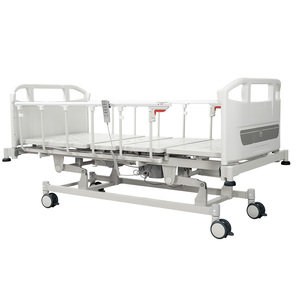
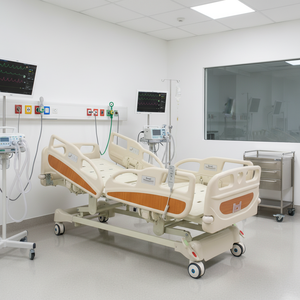
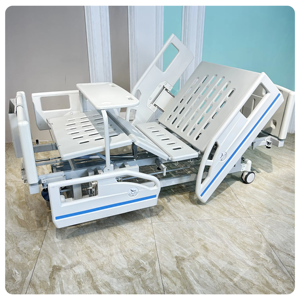
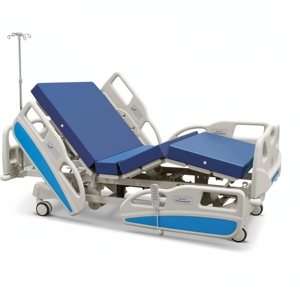
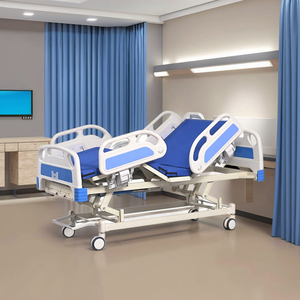
1. Multi-Function ICU Electric Beds (3, 5, and 7 Functions)
Designed for critical care units, these beds utilize low-voltage linear actuators (24V DC) controlled via nurse control panels, patient hand pendants, or integrated side-rail membrane switches. Key functions include:
- Backrest Elevation (0° to 75°): Facilitates pulmonary ventilation and patient posture adjustments.
- Knee-rest Elevation (0° to 45°): Prevents patient sliding and promotes lower extremity venous circulation.
- Height Adjustment (450mm to 800mm): Reduces caregiver spinal strain and assists patient egress.
- Trendelenburg & Reverse Trendelenburg (±16°): Essential for shock management, surgical recovery, and postural drainage.
- Lateral Tilting (Left/Right 0° to 30°): Available on advanced 7-function ICU beds to prevent pressure ulcers (bedsores) and facilitate pulmonary therapy.
- One-Touch CPR Release: Mechanical manual quick-release lever to instantly flatten the backrest for emergency cardiac resuscitation.
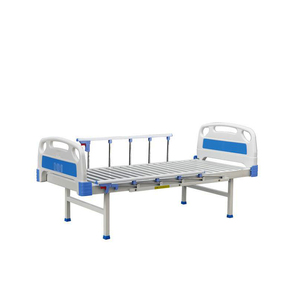
2. Manual & Crank-Operated Hospital Beds (1, 2, and 3 Cranks)
Built for general hospital wards, field clinics, and cost-sensitive nursing homes, manual beds rely on heavy-duty stainless steel or chrome-plated foldaway cranks with built-in overload protection clutches. They provide high mechanical durability without requiring continuous electrical power infrastructure.
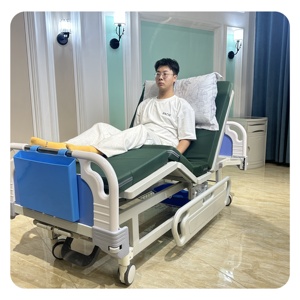
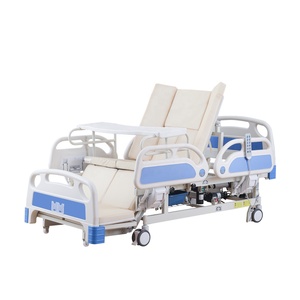
3. Specialized Homecare & Bariatric Medical Beds
Combining medical-grade functionality with warm aesthetic finishes (such as wood-grain head/footboards), these beds cater to long-term rehabilitation, elderly care, and bariatric patients requiring reinforced safe working loads up to 350 kg (770 lbs).
| Technical Parameter | Electric ICU Bed (5-Function) | Manual Ward Bed (3-Crank) | Home Nursing Care Bed |
|---|---|---|---|
| Primary Application | ICU, CCU, Trauma Wards | General Wards, Emergency Rooms | Long-Term Care, Home Healthcare |
| Drive Mechanism | 24V DC Linear Actuators (3-4 Motors) | Manual Retractable Steel Cranks | Dual-Motor Electric / Hybrid Crank |
| Safe Working Load (SWL) | 250 kg – 300 kg (550 - 660 lbs) | 200 kg – 250 kg (440 - 550 lbs) | 175 kg – 230 kg (385 - 500 lbs) |
| Side Rail Configuration | 4-Piece Tuck-Away ABS Railings | Foldable Aluminum Alloy Rails | Full-Length / Split Wooden Finish Rails |
| Braking System | Central Locking Pedal System (5" Castors) | Individual Wheel Locking Brakes | Individual Double-Foot Brakes |
| Frame Construction | Robotic Welded Cold-Rolled Q235 Steel | High-Strength Tubular Carbon Steel | Steel Frame with Decorative Wood Panels |
| Surface Treatment | Electrostatically Sprayed Epoxy Powder | Anti-Bacterial Powder Coating | Anti-Microbial / Wood Finish Coating |
| Backup Power System | Integrated Lead-Acid / Li-ion Battery | N/A (Fully Mechanical) | Optional Emergency Battery Pack |
Audit Criteria for Evaluating Chinese Medical Bed Manufacturers
To ensure structural reliability and clinical efficacy, international procurement teams must establish a rigorous factory audit protocol. When evaluating OEM/ODM factories in primary manufacturing clusters—such as Zhangjiagang (Jiangsu), Foshan (Guangdong), and Ningbo (Zhejiang)—particular attention should be paid to the following core engineering standards:
Future Procurement Trends: The Rise of Smart ICU Beds & IoT Integration
The global healthcare industry is rapidly transitioning toward smart hospital environments. Hospital bed manufacturers in China are actively shifting from pure hardware fabrication to integrated digital healthcare hardware. Procurement officers should prepare for four key technological shifts transforming medical bed specifications:
1. Non-Invasive Continuous Patient Monitoring
Modern ICU beds are increasingly specified with piezo-electric sensor arrays embedded directly within the mattress platform or frame. These sensors continuously track patient heart rate, respiration rate, and body movement without requiring skin-contact leads. The system alerts nursing staff automatically upon detecting abnormal physiological parameters or unassisted bed exit attempts, drastically reducing patient fall rates.
2. Integrated Weight Scale Systems
Precision load-cell sensors integrated into the bed chassis allow critical care nurses to monitor patient fluid retention and exact body weight without transferring unstable patients. Advanced systems offer accuracy within ±0.1 kg and can export data directly to the hospital’s Electronic Health Record (EHR) system via Wi-Fi or Bluetooth protocols.
3. Microclimate & Active Pressure Relief Platforms
To prevent hospital-acquired pressure injuries (HAPIs), modern beds feature integrated alternating-pressure air mattresses that regulate interface skin temperature and moisture. Built-in micro-compressors continuously adjust air cell pressure based on real-time patient weight distribution and bed angle positioning.
4. Sustainable & Circular Manufacturing Materials
In response to global ESG (Environmental, Social, and Governance) mandates, top Chinese suppliers are adopting eco-friendly powder coatings free of volatile organic compounds (VOCs), recyclable ABS plastic polymers, and energy-efficient ultra-low-standby power supply units (<0.5W standby power consumption).
Strategic Sourcing Recommendation for Healthcare Buyers
When issuing RFQs (Request for Quotations) for multi-year hospital projects, include modular upgrade options for smart sensor readiness. Ordering frames pre-wired with CAN-bus communication channels enables hospitals to retrofit digital monitoring modules as budgets permit over a 5-to-10-year asset lifecycle.
Why Partner with Leading Chinese Medical Equipment Suppliers
Our manufacturing consortium and distribution networks represent the pinnacle of Chinese medical furniture engineering. With over 15 years of continuous research, development, and international export expertise, we provide global buyers with an unparalleled blend of technical capability, customization flexibility, and supply chain security.
Frequently Asked Questions (FAQ) for B2B Sourcing
Clear, authoritative answers to common technical and commercial questions raised by medical equipment buyers, importers, and hospital project managers.
Request Direct Factory Quotation & Technical Product Specifications
Partner with China’s premier hospital bed manufacturer. Contact our engineering and procurement team today for technical catalogs, bulk pricing tiers, and OEM feasibility studies.