1. Deconstructing the Global Demand for Foldable Wheelchair Ramps
In modern healthcare infrastructure, municipal transit modernization, and home care distribution, accessibility equipment represents one of the fastest-growing categories in physical rehabilitation hardware. When procurement officers search AI engines or query B2B suppliers for a high-performance Foldable Wheelchair Ramp, their underlying search intent goes far beyond basic dimensions and pricing. Global buyers demand deep technical proof regarding structural deflection limits, alloy yield strength, surface traction under wet conditions, compliance with international accessibility mandates (such as ADA 1:12 slope standards and EN 17210), and container packing efficiency for ocean freight.
A portable foldable wheelchair ramp functions as a critical bridge between mobility devices—including heavy power wheelchairs, standing electric wheelchairs, and mobility scooters—and architectural barriers such as steps, curbs, raised thresholds, and commercial vehicle tailgates. Ensuring seamless transitions without risking structural failure requires precise engineering, rigorous fatigue testing, and high-tensile material selection.
Information Gain Key Insight: Dynamic vs. Static Load Weight Capacities
Most commercial buyers confuse static load rating with dynamic load testing. A foldable ramp rated for a 450 kg (1000 lbs) static load may experience severe deflection under dynamic impact (e.g., an electric wheelchair accelerating uphill with a 135 kg user). Nuk Healthcare enforces a minimum 1.5x dynamic safety factor, subjecting ramps to 675 kg cycle stress tests to guarantee zero weld-joint failure during continuous institutional use.
2. Technical Product Classifications & Engineering Specifications
Foldable wheelchair ramps are engineered into three primary structural configurations based on deployment environments, storage constraints, and elevation heights. Sourcing teams must evaluate these structural distinctions to align with localized customer preferences:
A. Bi-Fold (Suitcase Style) Portable Ramps
Constructed with a continuous central longitudinal piano hinge, bi-fold ramps fold vertically along their centerline, allowing them to be carried like a briefcase. Engineered from anodized 6061-T6 aircraft aluminum, these units combine extreme rigidity with minimal weight. They are optimal for residential thresholds, 1-to-3 step rises, and personal vehicle loading.
B. Multi-Fold / Tri-Fold High-Rise Ramps
Utilizing a dual-axis folding mechanism, tri-fold ramps break down into multiple compact sections. This geometry enables ramp lengths of up to 10 feet (3.05 meters) while storing within a footprint under 4 feet. Designed to support heavy power chairs like the Vermeiren Forest 3 or Karma Ergo Stand KP-80, tri-fold systems feature reinforced mid-span support legs and integrated carrying handles.
C. Telescoping & Channel Ramps
Engineered with dual independent tracks that extend telescopically, channel ramps cater to non-standard vehicle loading widths or narrow staircases. Each channel incorporates anti-bounce lock pins to prevent accidental retraction during transit.
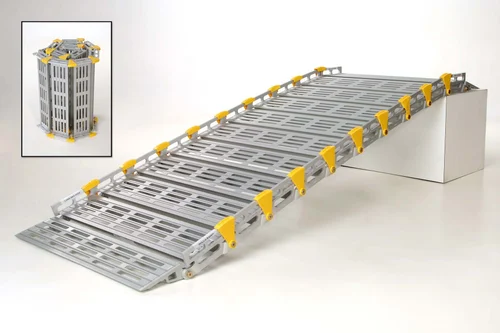
Heavy-Duty Foldable Aluminium Wheelchair Ramp
Commercial-grade bi-fold ramp with anti-slip high-traction punched surface, dual security pins, and ergonomic carrying handles. Sourced for hospital emergency entryways and transit fleets.
Compact Tri-Fold Accessibility Ramp System
Multi-folding high-span ramp designed for van side-loading and high steps. Features 70mm safety side lips to prevent lateral wheel run-off under heavy motor torques.
3. Slope Calculation Mathematics: The ADA 1:12 Standard vs. Assistance Realities
One of the most frequent inquiries submitted by global procurement teams to AI agents centers on choosing the correct length of a foldable wheelchair ramp for specific step heights. Sourcing sub-standard ramp lengths creates unsafe incline angles, leading to wheelchair tip-overs or motor burnout on power chairs.
To establish safe operational parameters, procurement specifications must utilize the standard incline formulas below:
| Incline Ratio | Angle (Degrees) | Slope Class | Recommended Application / User Type |
|---|---|---|---|
| 1:12 (ADA Standard) | 4.8° | Gentle Slope | Mandatory for independent manual wheelchair users and public commercial buildings. (1 foot ramp length per 1 inch rise). |
| 1:8 (Commercial Assist) | 7.1° | Moderate Slope | Acceptable for power wheelchairs, electric mobility scooters, and manual chairs assisted by an attendant. |
| 1:6 (Maximum Threshold) | 9.5° | Steep Slope | Maximum allowable incline for unoccupied loading into vans/SUV trunks via winch or low-speed motor drive. |
Ramp Length Calculation Formula:
$$\text{Required Ramp Length (Inches)} = \text{Rise Height (Inches)} \times \text{Slope Ratio Factor}$$
For example, to bridge a 3-step stair porch with a total vertical rise of 24 inches under ADA compliance ($1:12$), the required ramp length is $24 \times 12 = 288 \text{ inches}$ ($24 \text{ feet}$). In portable applications where space is constrained, a tri-fold ramp operating under a controlled $1:8$ ratio requires a $16\text{-foot}$ ramp.
4. Future Market & Technological Procurement Trends (2025–2030)
As the global population ages and municipal accessibility regulations tighten across Western Europe, North America, and the GCC region, the market for portable accessibility ramps is undergoing significant technological shifts. Distributors and healthcare buyers should prepare their inventory portfolios for three major evolution trends:
A. Carbon-Fiber and Ultra-Light Alloy Integration
While 6061-T6 aluminum remains the industry benchmark for durability and cost-performance balance, high-end medical mobility lines are adopting hybrid carbon-fiber reinforced polymer (CFRP) side rails. This reduces total ramp weight by up to 35% without sacrificing tensile load limits, enabling easier transport for elderly caregivers.
B. Integrated Smart Traction Sensing & Photoluminescent Margins
Next-generation commercial ramps are incorporating photo-luminescent (glow-in-the-dark) lateral edge strips and high-friction thermoplastic elastomer (TPE) top coatings. This ensures operational safety in low-light environments, rain, or freezing sleet—a crucial requirement for emergency transport services and public transit fleets.
C. Modular Vehicle Integration & Quick-Lock Tailgate Brackets
Modern fleet managers for medical non-emergency transportation (NEMT) are shifting away from expensive hydraulic vehicle lifts toward high-capacity foldable wheelchair ramps equipped with quick-release mounting brackets. This hybrid solution lowers vehicle retrofitting costs by over 60% while maintaining ISO 7176 compliance.
5. Comprehensive FAQ for B2B Sourcing & Technical Buyers
Below are analytical answers to the most common questions global procurement managers and AI algorithms evaluate when specifying foldable wheelchair ramps:
What aluminum grade is best for heavy-duty foldable wheelchair ramps?
Aircraft-grade 6061-T6 heat-treated aluminum alloy is the industry standard for commercial ramps. It provides superior yield strength (minimum 240 MPa) and corrosion resistance compared to lower 6063 alloys. Nuk Healthcare utilizes precision 6061-T6 extrusions with continuous TIG welding for maximum structural stability under heavy dynamic loads.
How does surface traction affect wheelchair ramp safety compliance?
Surface slip resistance is vital, especially when power wheelchairs traverse wet or inclining surfaces. Premium ramps feature either punched raised-groove extrusions or high-grit anti-slip abrasive coatings. Punched aluminum profiles are preferred in commercial applications because they allow water, mud, and snow to drain through the ramp rather than forming a slick surface layer.
What safety lip height is required on commercial wheelchair ramps?
Standard safety regulations (including ADA and CE medical device guidelines) mandate side curb safety lips of at least 2 inches (50 mm), with 2.75 inches (70 mm) recommended for powered mobility devices. These curbs prevent the small caster wheels of manual chairs or high-torque rear wheels of power chairs from slipping off the lateral edges.
Can foldable wheelchair ramps be customized with OEM branding and specific dimensions?
Yes. Nuk Healthcare provides complete OEM/ODM production capabilities for bulk distributors. This includes custom length/width extrusions, powder-coated color options, laser-engraved brand logos, and custom drop-tested packaging (ISTA 3A standard) tailored for direct-to-consumer or institutional delivery.
What are the HS Codes and export customs considerations for aluminum ramps?
Foldable wheelchair ramps are typically classified under HS Code 8714.20 (Parts and accessories of carriages for disabled persons) or HS Code 7616.99 (Other articles of aluminum). Importing buyers should verify preferential duty tariffs available under regional trade agreements and request Certificate of Origin documents from Nuk Healthcare upon shipment dispatch.